How to recognise a Montessori school
Five questions you can ask when you visit a school
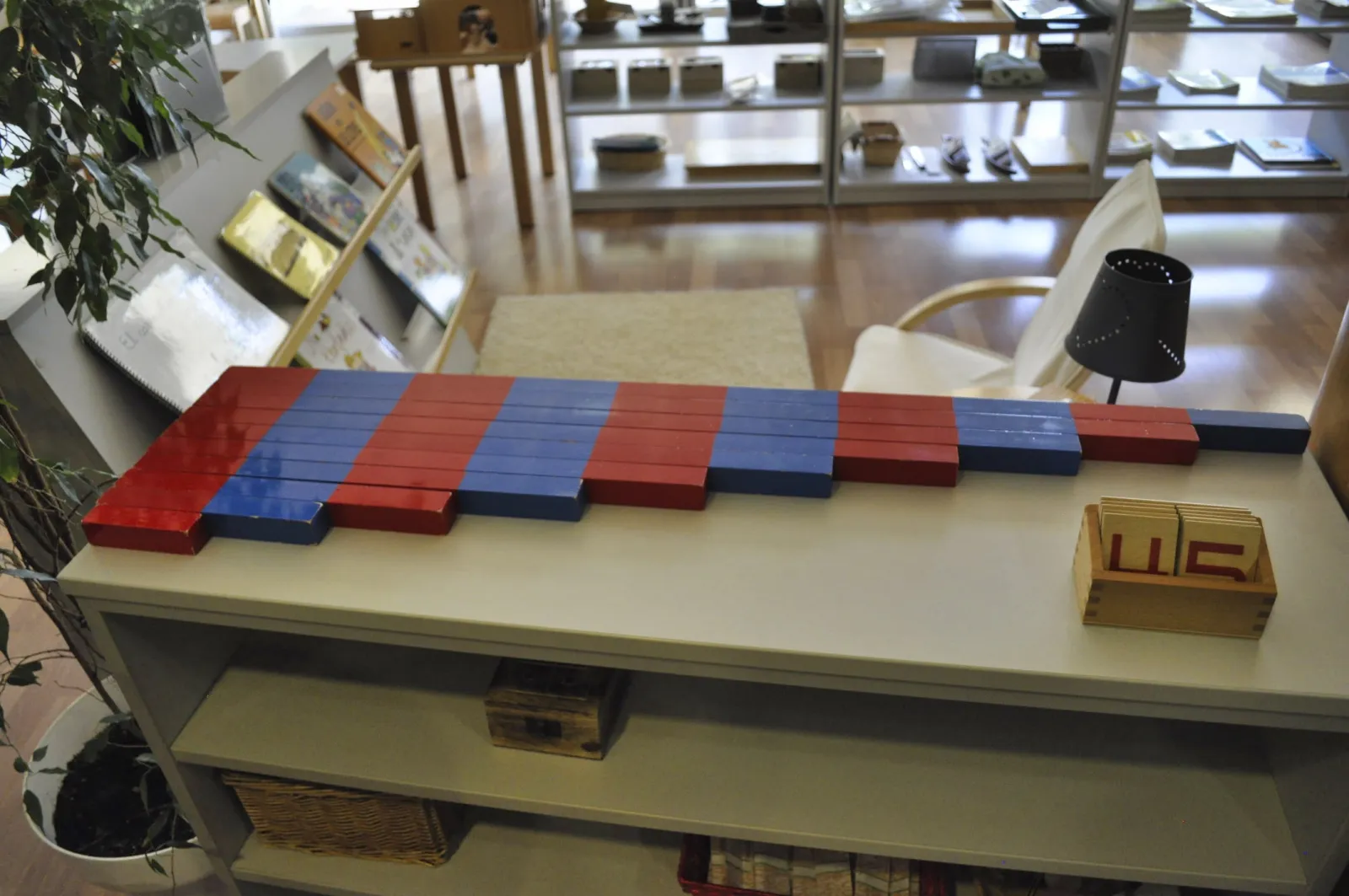
You can visit three schools that describe themselves as Montessori and find three fairly different ways of working.
Some differences are easy to see. Others go unnoticed until you know where to look and what to ask.
In this directory we gather information on five aspects: how the children are grouped, how long they can work without interruption, what materials are in the environment, how community life is sustained and what training the guides have.
None of them exhausts what Montessori means. We have chosen them because they can be described with a certain objectivity, because a school can explain them on its profile and because families can observe them or ask about them during a visit.
Together they offer a fairly reliable picture of how a school works.
How a Montessori school works
The cornerstone of the Montessori method is the idea that children learn best when they can act for themselves, choose their work and give it the time they need. Almost everything you will see in a classroom —how the children are grouped, the materials within their reach, the guide's role— grows out of that.
The environment is prepared to support autonomy. The materials are within the children's reach, they can move freely around the classroom and choose among different activities suited to their stage of development.
The word «guide» describes the adult's role quite well. They observe, accompany, present materials when the moment is right and help each child move forward at their own pace. They do not direct the activity of the whole class at once.
Maria Montessori also described four planes of development of six years each, between birth and the age of 24. Environments are organised with those stages and their characteristic needs in mind.
If you visit a Montessori school during the work period, it is common to find children of different ages doing different activities at the same time, some alone and some in small groups, while the guide observes, accompanies or presents materials individually.
The five questions
1. Do children of different ages share the same environment?
Montessori environments usually group children in cycles of around three years within each plane of development. The older ones help the younger ones, consolidate what they already know by explaining it and become a reference for those who arrive later.
As a reference, the usual environments are:
- Nido: from the first months until the child walks, at around 14 months.
- Infant Community: from when the child walks, at around 14-15 months, to age 3.
- Children's House: ages 3 to 6.
- Elementary: ages 6 to 12, as a single group or split into Lower (6-9) and Upper (9-12).
- Adolescent Community: ages 12 to 18. Few centres cover the full span. Many concentrate their programme in the early years and the rest of the stage is organised according to each country's education system.
The specific organisation varies with the project, the country and the stage. What we look for is a stable mix of ages within each environment.
What you can ask: what ages there are in the classroom your child would join, and how many children there are of each.
2. Do they have uninterrupted time to choose, focus and finish their work?
Concentration takes time to arrive. A child needs time to decide what to do, fetch the material, settle in and become fully absorbed in the activity.
In Montessori this period is known as the work cycle: a broad, self-directed span in which the guide avoids fragmenting the time with collective transitions or successive blocks of subjects.
Three hours is a classic reference, though the right length changes with the stage. As a guideline we take the thresholds published by the Pedagogical Commission of the Asociación Montessori Española (AME), affiliated with AMI:
- Infant Community (15 months to 3 years): 1.5 to 2 hours a day.
- Children's House (3 to 6 years): 2.5 to 3 hours a day.
- Elementary (6 to 12 years): 3 hours a day.
In the Nido we do not apply a time threshold, because at those ages the day is organised around care and rest.
Structure matters as much as length. A three-hour work period allows something that is difficult in a morning split into blocks of forty or fifty minutes: choosing an activity, going deep into it and finishing it without constant interruptions.
A short break or a shared snack does not break the cycle if afterwards each child returns to what they had chosen.
What you can ask: how long the work period lasts and what happens when playtime arrives and a child is absorbed in an activity.
What you can observe: whether during that time the children choose their own activity and work at their own pace, or whether at some point the guide directs the whole group towards the same task at the same time (a guide giving a presentation to a small group is a different matter).
3. Are there complete Montessori materials suited to the stage?
The materials are an essential part of the Montessori environment. Each one serves a specific purpose, is designed for a particular stage and forms part of a learning sequence.
Many also incorporate what Montessori called the control of error: they are designed so that the child can discover for themselves when something does not fit or when they have made a mistake, without constantly depending on an adult's correction.
For our criteria, the school must have suitable materials in the areas proper to each environment: Practical Life, Sensorial, Language, Mathematics, Cosmic Education and the areas specific to Elementary and the Adolescent Community, depending on the stage.
We look at the environment as a whole, not the presence of particular pieces.
This criterion is not met by materials used as decoration, imitations that do not fulfil the function of the original material, commercial «Montessori kits» used as a substitute for the environment, or the token presence of a few loose pieces.
In many Montessori environments there is a single copy of each material. Learning to wait, observe and take turns is also part of the learning.
What you can observe: whether the materials are within the children's reach, whether they are used naturally throughout the day and whether there is enough variety for each child to choose their work independently.
4. Is community life sustained without rewards or punishments?
In a Montessori school, the day-to-day running of the group does not rely on rewards or punishments. Motivation is sought in interest in the activity, in autonomy and in the satisfaction of learning.
That is why we do not consider stickers, point systems, medals, behaviour charts, performance rewards or punishments used routinely to direct the group's behaviour to be compatible with this approach.
Many authorised centres are required by their education authority to grade and issue reports, especially in Elementary and later stages. That is not incompatible with this criterion.
What we observe is whether grades are also used within the classroom as an everyday mechanism to motivate work or regulate behaviour.
Nor does this mean an absence of limits. Montessori environments have clear rules, which the guides present and uphold with firmness and respect.
What you can ask: what the guide does when a child interrupts another's work, or when a child has gone several days without choosing any activity.
5. Is there at least one guide with Montessori training in each environment?
Each environment has at least one guide with Montessori training corresponding to the stage it serves.
Substantial Montessori training usually includes in-person work with real materials and observation in an environment, and considerably more depth than an introduction or a one-off workshop. AMI, AMS and MACTE-accredited programmes are the best known, but they are not the only ones: there is also good Montessori training at universities and at other training centres.
Each school declares which guides with Montessori training there are in each environment and where their training comes from. That information appears on its profile, so you can see it and assess it for yourself.
What you can ask: what training the guide of the classroom your child would join has, where they did it and how long it lasted.
What these five criteria do not tell you
These criteria say nothing about how the school relates to families, about the stability of the team, about how conflicts are handled or about the specific person who will accompany your child each day. That a school meets these criteria indicates that its structure is consistent with Montessori pedagogy. But it does not say how each specific situation is resolved within the classroom, nor does it replace a visit to the centre.
That is why the profile is a starting point and the visit is the next step.
How this directory works
themontessori.world is an international directory of Montessori schools. We publish centres that work with this pedagogy in any of the stages between the ages of 0 and 18, from the Nido to the Adolescent Community.
The five criteria explained here are the ones a school meets to be part of the directory. The information about them is provided by the school itself, under its own responsibility, and appears on its profile so you can consult and cross-check it.
Some profiles begin from public information we have gathered before the centre takes part directly in the directory. These are the seeded profiles. They usually contain less information and fewer photographs, and may not yet include data on all the criteria described on this page.
The school can claim its profile, review it, complete it and manage it. If you represent a school, here we explain how to list it in the directory.
Each centre can also declare its pedagogical affiliations, the official authorisations that apply to it and the curriculum systems it works with. Alongside each declaration we ask for a link to the original source so that anyone can check it for themselves.
We organise and display this data, but we do not maintain or update the records of the organisations and authorities the centres belong to.
We are not a Montessori certifying body. We do not visit the schools, we do not issue quality seals, we do not individually assess the guides and we do not mediate in conflicts between families and schools.
Our work is to gather information, organise it, make it comparable and put it within your reach.
We may remove a school from the directory when it stops meeting the publication criteria or when other circumstances arise that are incompatible with the aims of this project.
If any data appears as «Not provided» or you want to look deeper into some aspect of the project, we encourage you to ask the school directly using the Request more information button.
Before you decide
Visit the school. Talk to the guides. If possible, observe an environment during the work period, and not only during an open-day event.
The profile can help you make a first selection, but getting to know a school means seeing it in action.
If you have doubts about any specific aspect, ask the centre directly. Cross-checking the information with the school itself is the natural step before making a decision.